
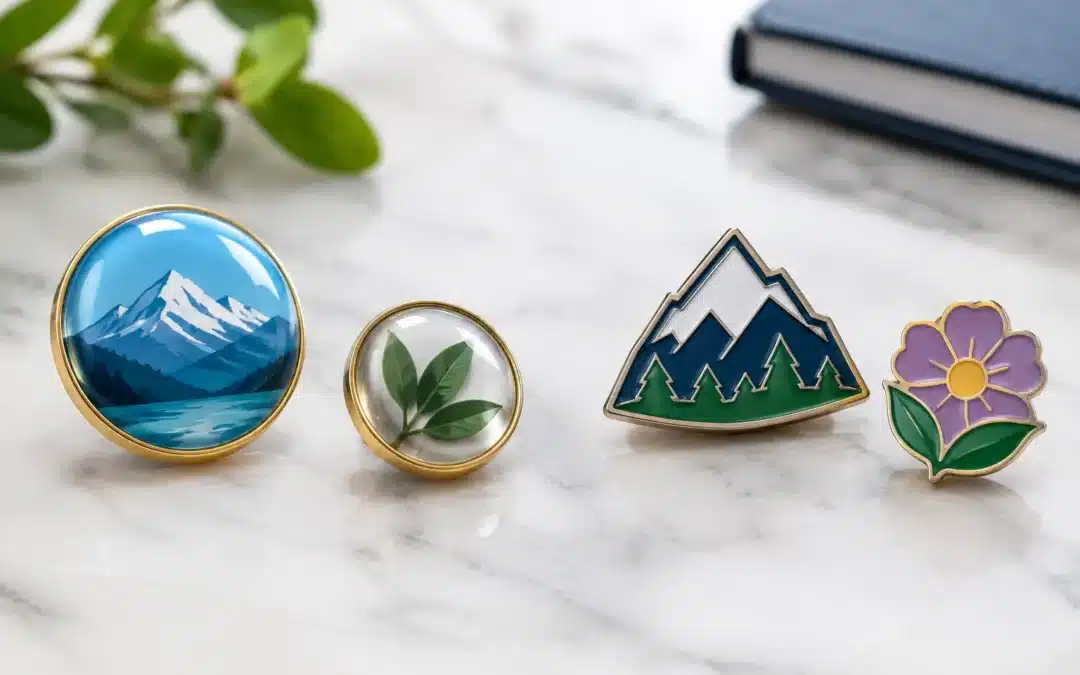
A great badge can turn a uniform, event lanyard or fundraising pack into something people want to keep. When comparing dome badges versus enamel, the best choice comes down to what needs to stand out: full-colour artwork and a glossy finish, or a premium metal pin with lasting detail. Both can make a strong impression, but they look, feel and perform differently in the real world.
For Australian businesses, schools, clubs and community groups ordering in volume, getting this decision right helps protect the budget while giving members, customers and guests a badge they are proud to wear.
Dome badges versus enamel: the key difference
A dome badge is typically a printed design finished with a clear polyurethane resin coating. The coating creates the raised, glass-like dome that gives these badges their name. Your logo, photo, gradient, fine text or detailed illustration sits beneath the clear surface, protected from scuffs and moisture.
An enamel badge is made from metal, usually with stamped or moulded outlines that separate the coloured areas of the design. Soft enamel has recessed colour fills and raised metal edges, giving it texture. Hard enamel is polished flat for a smoother, more refined finish. Both styles have the weight and presence people associate with a traditional lapel pin.
The difference is immediately noticeable. Dome badges are glossy, colourful and smooth. Enamel pins are dimensional, metallic and tactile. Neither is automatically better. The right option depends on your artwork, audience, intended use and the impression you want your merchandise to make.
Choose dome badges when artwork carries the message
Dome badges are a practical choice when your design includes detail that enamel cannot reproduce as cleanly. Think photographic images, complex illustrations, shaded colours, gradients, small print or a logo with multiple tones. Because the image is printed before the clear dome is applied, it can retain far more visual information than a design divided into enamel colour sections.
This makes domed badges particularly useful for promotional campaigns, visitor badges, staff identification, tourism merchandise and event giveaways. A real estate team might use a domed badge to display a detailed logo and contact details. A charity can include a campaign image and sponsor marks without simplifying the artwork beyond recognition. A school may use a vibrant mascot illustration with subtle shading.
The glossy coating also creates a polished, contemporary look. Colours appear vivid beneath the clear finish, and the surface is easy to wipe clean. For badges that will be handled frequently or included in a busy event pack, that protection is valuable.
Cost can be another reason to choose a dome badge. For designs with lots of colours or complicated artwork, printed dome production is often more economical than creating a metal enamel pin with many separate colour fills. This can make a noticeable difference on larger orders.
There are limits, though. Dome badges do not have the same metal weight or collectible feel as enamel. If your goal is to recognise a milestone, reward long service or create premium club merchandise, a domed badge can feel more promotional than ceremonial. The clear dome can also be less suitable for designs that rely on a classic, understated metal finish.
Choose enamel for a premium, lasting pin
Enamel badges suit designs that need a strong sense of quality, tradition or achievement. They are a natural fit for corporate recognition, sporting clubs, associations, commemorative events, memberships and formal uniforms. The metal base gives each pin substance, while the raised borders create clear definition around colours and shapes.
A simple logo often looks exceptional in enamel. Bold lettering, shield designs, mascots, icons and clean brand marks translate especially well. The metal lines do not just separate colours – they become part of the design. Gold, silver, antique brass and black nickel plating can all influence the final character of the badge.
Soft enamel is a popular option when you want visible texture and sharp raised metal edges. It provides an attractive, traditional badge finish and works well for clubs, community organisations and promotional merchandise. Hard enamel has a smoother, jewellery-like surface, making it a strong choice for executive gifts, anniversary pins and higher-end recognition pieces.
Enamel is also built for repeated wear. A well-made metal pin remains presentable through conferences, meetings, game days and regular uniform use. It is the sort of item recipients often keep on a pin board, jacket or cap long after the original event has passed.
The trade-off is artwork flexibility. Gradients, photographs and fine tonal changes do not suit conventional enamel production. Each colour needs its own enclosed area, and very small text may need to be enlarged or simplified. This is not a drawback when the design is created for enamel from the start, but it matters when adapting a detailed existing logo.
What happens to your logo in each finish?
The smartest choice starts with the artwork, not the badge style. A logo that looks excellent on a website may need a few practical adjustments to become an effective pin.
With a dome badge, almost any print-ready artwork can be reproduced with good fidelity. Pantone-matched colours can be closely represented, while imagery and subtle effects remain visible. This is ideal when brand consistency relies on more than two or three flat colours.
With enamel, artwork needs to be converted into distinct colour areas. Fine lines may need to be thickened, tiny gaps may be removed and lettering may need a larger size. A professional digital proof is essential here. It shows exactly how the metal outlines, colours, shape and attachment will work before production begins.
Do not assume simplification means compromise. Often, a clean enamel interpretation makes a logo more recognisable from a distance. The best lapel pins are easy to read at a glance, whether they are worn on a blazer at a conference or handed out at a school fundraiser.
Consider the badge shape as well
Dome badges can be produced in common shapes such as circles, ovals, rectangles and custom outlines, depending on the design and application. Enamel pins offer particularly strong shape flexibility because the metal itself can be cut to a custom silhouette. A state outline, mascot profile, product shape or crest can become part of the badge’s appeal.
If the outline is central to your concept, enamel may be the more memorable option. If the printed artwork is the hero, a dome badge often delivers more visual detail for the spend.
Budget, quantities and intended use
Custom badge pricing is influenced by size, quantity, number of colours, shape, finish and attachment. The most suitable option is not always the lowest unit cost. It is the one that meets the purpose of the order without paying for features your audience does not need.
For a large event where hundreds of attendees receive a branded item, dome badges can provide bright, detailed branding at an efficient price point. They work particularly well when the item is designed to support a campaign, launch or one-off promotion.
For membership badges, award pins or merchandise that represents belonging, enamel often earns its higher perceived value. A sporting club celebrating premiership players, for example, may want the durable metal finish and commemorative quality of enamel. A national conference using a detailed event illustration may get more impact from a domed finish.
Attachments matter too. Butterfly clutches are common for lapel pins, while magnet backs are useful where you want to avoid pin holes in shirts or uniforms. A magnet option can be especially popular for staff name badges, though the best attachment depends on the size and weight of the finished badge.
A quick way to make the decision
Choose a dome badge if your design contains photographs, gradients, many colours or fine printed detail, and you want a glossy promotional finish. Choose enamel if you want a metal pin that feels premium, has clean flat colours and will be worn as a mark of membership, achievement or brand pride.
If you are between the two, ask one question: what should people notice first? If the answer is the artwork, choose the finish that preserves it. If the answer is the badge itself, enamel usually has the stronger physical presence.
At Lapel Pins Australia, a free digital proof helps turn that choice into a clear production plan before your order goes ahead. Bring your logo, rough idea or existing artwork to the conversation, and focus on the outcome you want recipients to remember: a small badge with a big impact.