
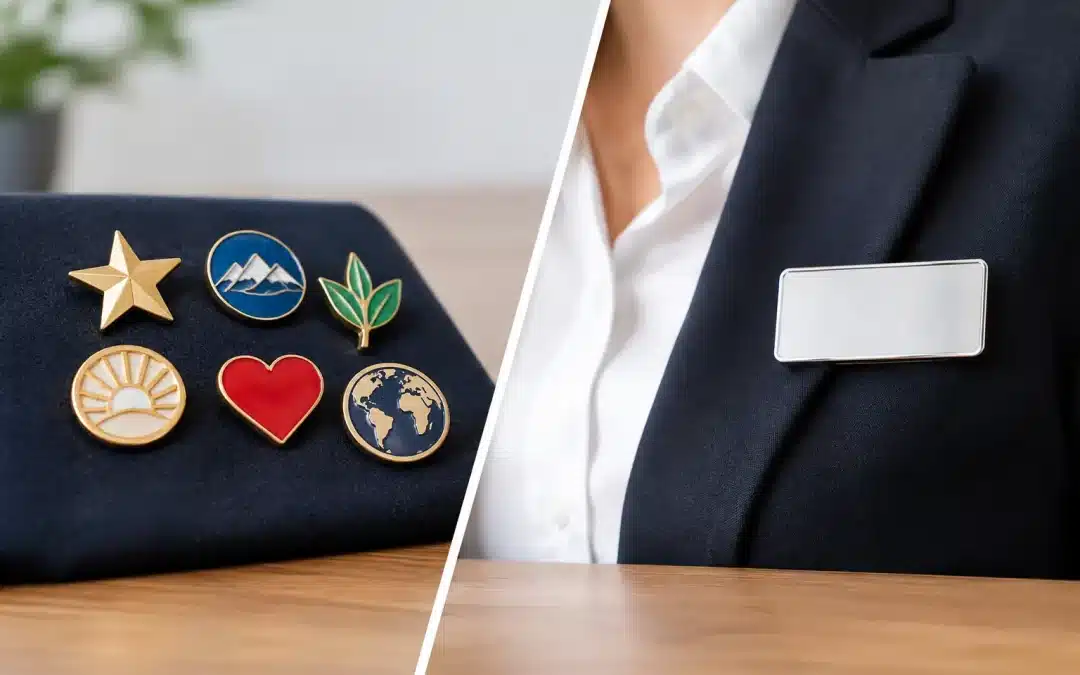
A staff member arriving at a busy trade show needs to be recognised straight away. A volunteer receiving an award wants something worth keeping. Those two moments highlight the real choice in pins versus name badges: one is built for lasting identity and visual impact, while the other makes introductions quick and easy. The best option depends on what you need the item to do after it is worn.
For Australian businesses, schools, clubs, charities and event organisers, both products earn their place. The key is choosing the format that supports your goal, whether that is stronger branding, clearer identification, fundraising, recognition or a polished team presentation.
The key difference between pins and name badges
Custom lapel pins are small branded items usually made from metal, acrylic or PVC. They can feature a logo, mascot, campaign message, event artwork or achievement design, and are typically worn on a lapel, collar, lanyard, hat or bag. Their purpose is often promotional, commemorative or symbolic.
Name badges are primarily practical identification tools. They display a person’s name and, in many cases, their job title, organisation or department. They are common at conferences, customer-facing workplaces, school events, expos and community functions where attendees need to know who they are speaking with.
That distinction matters. A name badge says, “I am here and this is who I am.” A lapel pin says, “I belong to this group, I support this cause, or I am proud of this achievement.” One can be temporary and person-specific; the other can become a keepsake that continues promoting your organisation long after the event finishes.
Pins versus name badges for visibility and value
Brand impact and design freedom
Pins generally offer more creative freedom. Your design can be made in a custom shape, matched closely to Pantone colours and finished with polished metal, soft enamel, hard enamel, printed artwork, epoxy coating, 3D detailing or colourful PVC. That gives a small badge a big impact, especially when the design needs to feel premium or collectable.
Name badges can still look professional, particularly with full-colour printing and a clear layout, but their design needs to prioritise legibility. If the wearer’s name cannot be read at a glance, the badge is not doing its job. Large logos, intricate artwork and too much copy may work beautifully on a pin but can crowd a name badge.
For a brand launch, sports club membership drive or charity campaign, pins usually create the stronger visual statement. For a registration desk, retail team or networking breakfast, name badges make more immediate practical sense.
Personal recognition versus personal identification
A custom pin is ideal when the recipient has earned something. Years of service, volunteer appreciation, graduation, fundraising milestones, committee membership and sporting achievements all suit a pin because it feels more permanent than a printed pass or sticker badge.
A name badge is better when people need to start conversations quickly. It helps customers find the right staff member, gives new team members confidence and reduces awkward introductions at a large event. Adding a role such as Event Coordinator, Coach or First Aid Officer can be just as useful as the name itself.
There is also an emotional difference. People tend to return a name badge at the end of a function. They are far more likely to take a well-designed lapel pin home, add it to a collection or wear it again.
Lifespan, cost and reuse
If you need a low-cost identifier for a one-day conference, printed name badges are often the efficient choice. They can be produced for individual delegates and updated as registrations change. Reusable name badges with replaceable inserts are another practical option for workplaces with staff turnover.
Pins require custom manufacturing, so they are usually best suited to bulk quantities and designs you plan to use repeatedly. Their value comes from durability and perceived quality. A well-made metal enamel pin can be worn for years, making it a cost-effective promotional piece when measured over its full life rather than a single event day.
The right comparison is not simply which item costs less per unit. Ask how long it needs to work, who will wear it and whether it is meant to be kept. A pin can deliver ongoing brand exposure. A name badge can make a room of strangers easier to navigate within minutes.
When custom lapel pins are the better choice
Choose pins when you want your branding to travel beyond the immediate occasion. They work particularly well for clubs welcoming new members, schools recognising student leaders, businesses rewarding staff, charities thanking supporters and event organisers selling commemorative merchandise.
They are also a strong option for campaign awareness. A simple, recognisable design can be worn on a jacket, uniform or backpack, sparking conversations without requiring a large promotional display. For fundraising, limited-edition pins can add a tangible reason for supporters to donate or participate.
Attachment choice affects how the pin will be used. Butterfly clutches are a popular standard for lapels and fabric. Magnet attachments avoid piercing delicate clothing and suit corporate uniforms or presentation wear. Brooch-style fittings can work well for larger designs. The best attachment depends on the pin size, weight and where it will be worn.
Material matters too. Die-struck enamel pins bring a classic, durable finish for logos and achievement awards. Printed pins are useful for detailed artwork, photographs or colour gradients. Acrylic pins can offer a lighter, budget-conscious option, while PVC suits bold, flexible designs with a casual feel.
When name badges are the better choice
Name badges are the clear winner when recognition needs to happen instantly and accurately. A medical practice receptionist, a school volunteer, a retail assistant or an expo exhibitor should not have to explain who they are before they can help someone.
They are especially useful when names change from event to event. Conference delegates, workshop participants and visitors can be issued personalised badges without committing to a permanent product for every attendee. For recurring functions, use a consistent branded badge layout with variable names and roles.
Keep the design clean. Your organisation logo should support the badge, not compete with the wearer’s name. Use a readable font, strong colour contrast and enough space for names that may be longer than expected. If people will be standing several metres apart, larger text is worth more than an elaborate background.
For customer-facing teams, consider whether names should be first name only or include a role. This can create a friendlier experience while still giving staff appropriate privacy and clarity.
Why many organisations use both
Pins and name badges are not always competing products. In many cases, they do different jobs at the same event or within the same organisation.
A conference team may wear name badges so delegates can identify speakers, organisers and support staff, while presenters receive a commemorative enamel pin. A sporting club might give committee members branded pins for formal occasions and use name badges at registration days. A business can issue name badges to daily customer-service staff, then recognise five-year and ten-year milestones with premium lapel pins.
This approach gives you function and recognition without forcing one product to do everything. It also creates a more considered experience for staff, volunteers and guests.
How to choose the right custom option
Start with the wearer and the moment. If a person must be identified by name today, choose a name badge. If you want them to represent your organisation proudly over time, a pin is likely the better investment.
Next, consider the artwork. A clean logo, emblem or message can translate well into a pin. Detailed graphics may need a printed finish rather than enamel. For name badges, focus on the information people need to read first, then build the branding around it.
Finally, think about quantity and timing. Custom pins are made to order and benefit from early planning, particularly for major events, large campaigns and presentation boxes. Requesting a free digital proof before production gives you the chance to check colours, shape, wording and fine details before your order is made.
With more than 20 years of experience, Lapel Pins Australia can help turn a logo or idea into a practical custom pin that looks the part and arrives ready for your event, campaign or recognition programme.
The strongest choice is the one that gives each wearer a clear reason to put it on. Make names easy to read when connection matters most, and choose a custom pin when you want your message, membership or achievement to stay visible well beyond the day.