
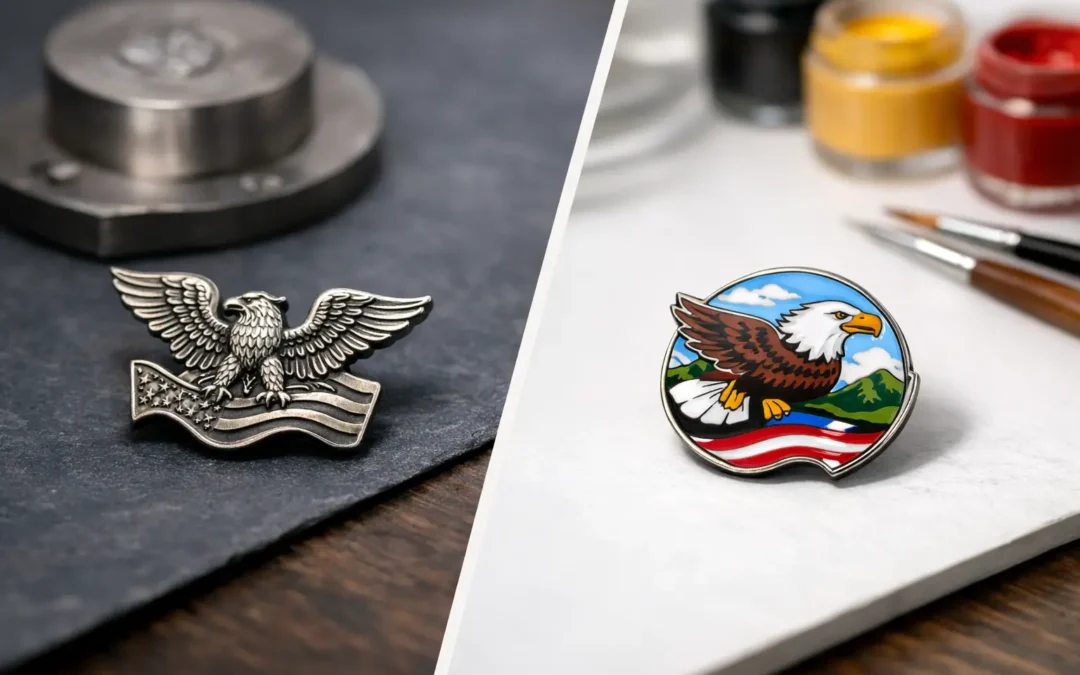
When you are ordering custom pins for a school, club, campaign or corporate event, the artwork usually looks great on screen. The real question is how that design will translate into a finished product. That is where die struck pins vs printed becomes a practical decision, not just a design preference.
Both options can look sharp, professional and on-brand. But they achieve that result in very different ways. If you are choosing pins for recognition, fundraising, staff awards, retail resale or event merchandise, understanding the strengths of each style will help you get better value and a better result.
Die struck pins vs printed: the core difference
A die struck pin is made by stamping your design into metal. That process creates recessed and raised areas, giving the pin texture, depth and a more traditional premium feel. Depending on the finish, it can look polished, formal or highly collectible.
A printed pin works more like a miniature printed graphic. Your design is applied onto a flat metal surface, which allows for finer visual detail, gradients and more flexibility with complex artwork. Many printed pins are finished with an epoxy coating to add protection and a smooth surface.
The easiest way to think about it is this: die struck pins are built from metal lines and structure, while printed pins are built from artwork reproduction. Neither is automatically better. It depends on what you need the pin to do.
When die struck pins are the better choice
If you want a pin that feels substantial in the hand and has a more classic badge-like appearance, die struck is often the stronger option. This style suits organisations that want a polished, lasting impression. Think staff service awards, government or association pins, school leadership badges, commemorative issues and branded corporate pins where presentation matters.
Because the design is physically stamped into the metal, die struck pins tend to carry a sense of craftsmanship that printed pins do not replicate in quite the same way. Metal outlines create definition, and the raised edges give the design a cleaner, more dimensional finish.
This style is especially effective when your logo or artwork is relatively simple and bold. Strong shapes, clear borders and limited colour areas usually translate well. If you are using enamel infill, the metal lines help separate colours neatly and keep the design looking crisp.
There is also a durability advantage in the overall construction. A die struck pin is less about surface graphics and more about formed metal. For long-term use, membership programs or repeat wear, that can be a real benefit.
When printed pins make more sense
Printed pins come into their own when your design is visually complex. If you have fine text, facial features, gradients, shadows, photographic elements or intricate branding details, printing gives you more freedom. Instead of simplifying your artwork to fit metal borders, you can reproduce more of the original design.
That makes printed pins a popular choice for event branding, promotional giveaways, fundraising campaigns and short-run concepts where visual accuracy matters more than metallic depth. If your logo has subtle colour transitions or small design elements that would be difficult to separate with metal lines, printed is often the smarter path.
Printed pins can also be more cost-effective, particularly for designs that would be challenging or labour-intensive to convert into a die struck format. If the brief is to produce an attractive branded pin at a sharp price point, printed may deliver the best balance.
An epoxy coating can further improve the result by adding a glossy, protective layer over the print. This helps the pin feel more finished and can provide reassurance for customers who want a smooth, durable surface.
Appearance: texture versus artwork detail
For many buyers, the decision comes down to visual style.
Die struck pins usually look more premium at first glance because they reflect light off the metal and offer visible depth. They feel like a traditional lapel pin. If your audience is expecting something commemorative, official or high-end, that texture matters.
Printed pins look flatter, but they can be more visually detailed. They allow you to keep the design closer to your original artwork, especially if the image includes subtle colours or complicated elements. For promotional use, this can be a major advantage because brand consistency often matters more than dimensional effect.
So the trade-off is straightforward. Die struck gives you character, depth and a more classic finish. Printed gives you precision, flexibility and stronger reproduction of detailed graphics.
Cost and value in bulk orders
Budget always matters, especially for schools, clubs, charities and large event orders. The better question is not just which option is cheaper, but which option gives better value for your goal.
Die struck pins can represent strong value when the design is simple and the aim is a quality presentation piece. They often create a stronger perceived value, which is useful if the pins are being sold, awarded or presented in a formal setting.
Printed pins can be more economical for artwork-heavy designs because you avoid some of the design constraints and production complexity that come with formed metal sections. If you need a large quantity for giveaways or campaign merchandise, printed pins can help keep the project within budget without sacrificing brand visibility.
For many customers, the right answer sits somewhere between aesthetics and quantity. A premium board member pin and a mass-distribution event pin do not need to be made the same way. Matching the production method to the purpose is usually the smartest spend.
Design limitations matter more than most people expect
This is where expert guidance saves time.
A design that looks perfect in a digital proof can still behave differently once it is turned into metal. Die struck pins require artwork to be interpreted into raised and recessed areas. That means tiny details may need to be simplified, text may need to be enlarged and very close colour sections may need stronger separation.
Printed pins are more forgiving with detail, but they rely heavily on print quality and artwork resolution. If the file is poor or the design is overcrowded, the final pin can still feel busy at small size.
That is why free artwork guidance and a digital proof are so valuable. A good supplier will not simply take the file and hope for the best. They will recommend the production style that suits the design, the budget and the intended use.
Which style suits your audience?
A corporate recognition pin, a school badge and a charity fundraiser may all be called lapel pins, but they are not the same purchase.
If you are presenting pins as awards, achievements or official identifiers, die struck is often the better fit. It gives the product more authority and presence. People tend to keep these pins longer because they feel significant.
If you are creating branded merchandise for an event, campaign or fundraising push, printed pins can be ideal. They let you capture colourful artwork, mascots, slogans and theme graphics without overcomplicating the manufacturing process.
For retail-style pin designs, it really depends on the art. Bold, simple icon-based designs can look excellent as die struck enamel pins. Illustrative or highly detailed designs often perform better as printed pins.
Die struck pins vs printed for fast decision-making
If your design is simple, your brand needs a premium finish and the pin will be used for recognition or long-term wear, die struck is usually the safer choice. If your design is detailed, your budget is tighter or visual accuracy is the priority, printed is often the better option.
There are exceptions. A simple printed pin can still look polished, and a well-designed die struck pin can be very cost-effective in volume. That is why this decision should be based on artwork, audience and use case together, not on one factor alone.
At Lapel Pins Australia, this is the part where hands-on advice makes the process easier. You do not need to know every production detail before asking for a quote. If you can share the artwork, quantity and purpose, the right pin style becomes much clearer.
A small badge can do a lot of work for your brand, your event or your organisation. The best choice is the one that looks right, wears well and makes sense for the people receiving it. If you are deciding between die struck and printed, start with the end use and let the design follow from there.